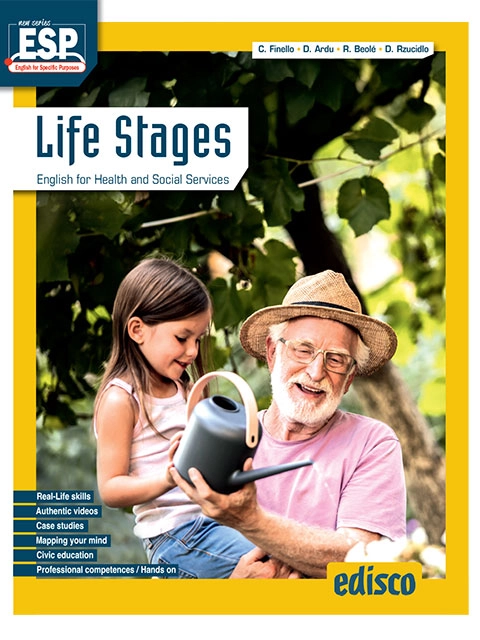
Life Stages
English for Health and Social Services
Carla Finello, Doretta Ardu, Raffaella Beolé, Dominika Rzucidlo
Edisco

VERSIONE DIGITALE

21.80

Cover

Descrizione

Argomento e obiettivi del testo

Life Stages è un corso di inglese specialistico per il settore dei Servizi per la sanità e l’assistenza sociale.

I contenuti sono ordinati secondo criteri di graduale complessità concettuale e linguistica e vengono esplorati utilizzando le quattro abilità in modo omogeneo e integrato.
I brani offrono un assortimento di stili, registri e livelli di difficoltà, e sono tratti da fonti diverse ed autentiche: libri e manuali, riviste e quotidiani online e siti web, anche specialistici.

Il testo si propone di:

  • far acquisire le competenze necessarie per comprendere testi che presentano termini, espressioni, strutture sintattiche e modalità discorsive specifiche del linguaggio settoriale;
  • migliorare le capacità di ricezione e produzione orale e scritta, anche tramite attività tipo Preliminary, FCE e IELTS;
  • consolidare abitudini grammaticali corrette;
  • incoraggiare l'autonomia linguistica e la soluzione di problemi;
  • stimolare l'interesse e la partecipazione attiva degli studenti, dando spazio alla loro esperienza personale e a problematiche di attualità.
La struttura
Life Stages è diviso in sette Moduli, ognuno dei quali ripartito in un numero variabile di Unità.
Ogni Unità è suddivisa in brevi Capitoli su due pagine – teoria ed esercizi – per favorire sia uno studio più parcellizzato, sia la scelta antologica da parte dell'insegnante.

Brevi link (curiosità, ampliamenti, rimandi, attività o mini-approfondimenti) arricchiscono i brani per consentire una maggiore interattività. Un ricco apparato iconografico correda i brani di lettura, per ognuno dei quali è previsto un esauriente glossario.

Ogni Unità si conclude con due sezioni:

  • Vocabulary: con specifiche attività di revisione e consolidamento del lessico;
  • Mapping your Mind: mappa riepilogativa per rappresentare la rete di relazioni tra i vari argomenti dell'unità.
Alla fine di ogni Modulo, il testo propone ulteriori attività:

  • Key people: persone influenti nell'ambito dell'argomento trattato;
  • Case study: analisi di un evento, un'organizzazione o un problema specifico;
  • Clip: brevi filmati tratti da opere cinematografiche;
  • Civic education: tematiche legate all'educazione civica e alla cittadinanza.
Un ultimo modulo extra comprende:

  • Hands on: informazioni, consigli utili ed esercizi di role-play per immergersi in situazioni lavorative realistiche;
  • Grammar: ripasso degli argomenti più importanti della grammatica inglese con lessico specifico del settore socio-sanitario;
  • Spunti interdisciplinari.
Contenuti digitali integrativi

  • Video per attività di listening e speaking
  • Tracce audio in formato mp3
  • Schemi e mappe interattive
  • Testi per attività di approfondimento e di esercitazione
  • Schede di civiltà comparata UK vs US
Teacher's Book. Disponibile sia in formato cartaceo sia digitale.

  • Programmazione didattica / Piano di lavoro
  • Didattica inclusiva e BES
  • Agenda 2030
  • Test di verifica di tutte le Unità e i Moduli, in formato editabile
  • Soluzioni degli esercizi e note didattiche
  • Audioscript delle attività di ascolto e dei video


Indice

MODULE 1 – BODY AND MIND13Unit 1.1 – The human body14The human body, an introduction14Cells and tissues16The skeletal and muscular systems18The nervous and endocrine systems20The cardiovascular and respiratory systems22The digestive and urinary systems24The reproductive system26The sensory systems28VOCABULARY30MAPPING YOUR MIND31Unit 1.2 – Keeping a body healthy32A healthy diet32Vitamins and minerals34Illnesses from food36Hygiene38Prevention40Vaccines42VOCABULARY44MAPPING YOUR MIND45Unit 1.3 – The human brain and mind46The human brain46The limbic system48Memory50Language52Emotions54Imagination56VOCABULARY58MAPPING YOUR MIND59Unit 1.4 – Keeping a mind healthy60Psychology60Psychotherapy62Psychiatry64VOCABULARY66MAPPING YOUR MIND67KEY PEOPLE68CASE STUDY – Joseph Lister's antiseptic method and spray apparatus69CLIP FILM – Inside Out70CIVIC EDUCATION – Vax or no-vax?72MODULE 2 – BABIES AND CHILDREN73Unit 2.1 – Up to the birth74Preconception74Pregnancy76Antenatal screening tests78Labour and birth80VOCABULARY82MAPPING YOUR MIND83Unit 2.2 – Babies84The first months after birth84Breastfeeding86Weaning88Sleeping90Growth, from 0 to 12 months92Fears and anxieties94Needs96VOCABULARY98MAPPING YOUR MIND99Unit 2.3 – Children100Physical and intellectual development100Health checks and common diseases102Contagious diseases and vaccinations104Fears and phobias106Needs108VOCABULARY110MAPPING YOUR MIND111Unit 2.4 – Developmental and educational theories112Freud112Piaget114Erikson116Other theories118Play theories120VOCABULARY122MAPPING YOUR MIND123Unit 2.5 – Childcare124In-home care124Out-of-home care126The school system in Italy128The school system in the UK130Childcare legislation and support132VOCABULARY134MAPPING YOUR MIND135KEY PEOPLE136CASE STUDY – The curious case of baby cages137CLIP FILM – Harry Potter and the Order of the Phoenix138CIVIC EDUCATION – Marks or no marks at school?140MODULE 3 – ADOLESCENTS141Unit 3.1 – Physical and social issues142Physical changes142Needs144Physical problems146Parental and academic pressure148Peer pressure150Bullying and cyberbullying152Relationships and contraception154VOCABULARY156MAPPING YOUR MIND157Unit 3.2 – Psychological issues158Body acceptance and gender identity158Anxiety, FOMO, and hikikomori160Food disorders162Addictions: drugs and alcohol164Addictions: tobacco and others166VOCABULARY168MAPPING YOUR MIND169KEY PEOPLE170CASE STUDY – The story of Karen Carpenter171CLIP FILM – The Perks of Being a Wallflower172CIVIC EDUCATION – Body shaming174MODULE 4 – ADULTS AND ELDERLY PEOPLE175Unit 4.1 – Adults176Physical changes176Needs178Common physical issues180Psychological issues182Social issues184VOCABULARY186MAPPING YOUR MIND187Unit 4.2 – The elderlyPhysical changes188Needs190Minor physical issues192Major physical issues194Social issues196VOCABULARY198MAPPING YOUR MIND199Unit 4.3 – Serious diseases of old age200Parkinson's200Dementia202Alzheimer's204Cardiovascular diseases206VOCABULARY208MAPPING YOUR MIND209Unit 4.4 – Eldercare210Daily activities and support210In-home care212Out-of-home care214Legislation in support of eldercare216VOCABULARY218MAPPING YOUR MIND219KEY PEOPLE220CASE STUDY – Community solidarity for the elderly in Udine221CLIP FILM – On Golden Pond222CIVIC EDUCATION – Adopt a grandparent224MODULE 5 – DIFFICULTIES225Unit 5.1 – Physical and mental disorders226Down syndrome226Autism and Asperger228Epilepsy230Mental illnesses232Physical disability and chronic diseases234Intellectual disability236Minor disorders238Learning disorders240VOCABULARY242MAPPING YOUR MIND243Unit 5.2 – Social issues244Poverty, unemployment, and homelessness244Drug addiction and rehabilitation246Gender issues248Domestic violence and child abuse250(Im)migrants, refugees, and asylum seekers252Discrimination, racism, and marginalisation254VOCABULARY256MAPPING YOUR MIND257KEY PEOPLE258CASE STUDY – Asylum seekers in Europe259CLIP FILM – The Pursuit of Happyness260CIVIC EDUCATION – No poverty262MODULE 6 – SOCIETY HELPS263Unit 6.1 – The family264The role of the family and parenting264Types of families266Adopting and fostering families268VOCABULARY270MAPPING YOUR MIND271Unit 6.2 – The institutions272Social services272Hospitals274Public social services agencies, community and rehabilitation centres276Mental health services278VOCABULARY280MAPPING YOUR MIND281Unit 6.3 – Social welfare282Health and safety at work282Social security284Welfare and subsidies286The healthcare system288National insurance against accidents at work290Benefits for disabled people292VOCABULARY294MAPPING YOUR MIND295Unit 6.4 – Associations and volunteers296Research centres296Voluntary associations298Charities300VOCABULARY302MAPPING YOUR MIND303KEY PEOPLE304CASE STUDY – The affordable care act (Obama Care)305CLIP FILM – A Beautiful Mind306CIVIC EDUCATION – The abolishment of psychiatric hospitals in Italy308MODULE 7 – WORK309Unit 7.1 – Communication310What is communication?310Forms of communication312Communication in health and social care314Special forms of communication316VOCABULARY318MAPPING YOUR MIND319Unit 7.2 – Looking for a jobProfessional skills320Where and how to look for a job322The curriculum vitae and the cover letter324The job interview326VOCABULARY328MAPPING YOUR MIND329Unit 7.3 – Careers330Clinical and medical careers330Mental health and well-being careers332Careers in education334Public health and community care careers336Administrative and support careers in healthcare338VOCABULARY340MAPPING YOUR MIND341KEY PEOPLE342CASE STUDY – Miscommunication in healthcare343CLIP FILM – CODA344CIVIC EDUCATION – Gender equality346MODULE 8 – EXTRA347Unit 8.1 – Hands on348Consulting a doctor348Dealing with tantrums349Reading a prescription350Dealing with violence among children351Dealing with bullying352Checking a place is accessible for people with physical disabilities353Dealing with a stubborn patient354Dealing with abused women355Approaching an autistic child356Playing with children357Creating a relationship with an immigrant358Organising group activities359Talking to an old person with dementia360Reading a blood test361Reading a certification of an SEN student362Calming a crying baby363Dealing with a panic/anxiety attack364Talking to an addicted person365Reacting to an epilepsy seizure366Talking to a fluid person367Helping an SEN student with their homework368Talking about an incurable disease369Unit 8.2 – Grammar370Present tenses370Past tenses372Future tenses374Conditionals, wish clauses376Prepositions378Comparatives and superlatives380Quantifiers382Relative pronouns384Articles386Modals, semi-modals and similar verbs: present and future388Modals, semi-modals and similar verbs: past390Passive and causative verbs392Reported speech394Unit 8.3 – Spunti interdisciplinari396Prompt no. 1 – Picture396Prompt no. 2 – Literary text397Prompt no. 3 – Literary text398Prompt no. 4 – Article399Prompt no. 5 – Key word400Prompt no. 6 – Case study401Prompt no. 7 – Graph402Prompt no. 8 – Project403Glossary404

Dettagli

EditoreEdiscoPagine412ISBN97888441221199788844172114

Altro in "Inglese"

Altri volumi degli stessi autori

VERSIONE DIGITALE

21.8

Apri